






This Industry Viewpoint was authored by Gerry Christensen
The outbound enterprise calling landscape is standing on the precipice of its most profound structural shift since the inception of the STIR/SHAKEN framework. For years, the telecommunications industry has wrestled with a fractured trust ecosystem where bad actors thrived on malicious anonymity, and legitimate businesses were forced to pay a premium just to prove they weren’t scammers.
However, a massive wave of anticipated FCC rulemakings regarding all-IP networks, identity, and Know Your Customer (KYC) compliance is about to completely flip the script.
By weaponizing basic market economics rather than relying solely on regulatory caps, the FCC is poised to standardize identity at the baseline network level. This regulatory correction will trigger a fascinating economic cascade: while it will make thorough KYC an absolute necessity for all enterprises, it will simultaneously cause the cost of branded calling to plummet.
The New Trust Baseline: Vetting, Monitoring, and A-Level Attestation
Achieving a truly trusted A-level attestation under STIR/SHAKEN is transitioning from a basic, passive routing handshake into a rigorous, identity-centric verification process. Historically, voice service providers practiced passive monitoring, allowing traffic to pass without looking too deeply at who was behind the curtain. Those days are officially over.
Under the upcoming FCC framework, providers are being pushed toward systemic accountability. To ensure an enterprise legitimately deserves an A-level attestation, the ecosystem will now heavily rely on two vital, specialized oversight roles:
- Vetting Agents*: These entities act as the front line of the onboarding process. They conduct a deep-dive validation of corporate registry records, tax IDs, and explicit Rich Caller Data (RCD) payloads to guarantee that the organization claiming the phone number is exactly who they say they are.
- Monitoring Agents*: Trust is not a one-time stamp of approval; it must be continuously earned. Monitoring Agents perform ongoing behavioral surveillance and post-onboarding oversight to ensure an enterprise does not slip into abusive or fraudulent traffic patterns after gaining network access.
*Note: Vetting Agent currently exists in the BCID ecosystem, but “Monitoring Agent” is something proposed by Gerry Christensen to ensure that vetted entities behave in the way they are expected.
Operational Reality: This paradigm shift means KYC will be necessary for all enterprises wanting access to high-tier network trust. Because this introduces upfront operational friction and overhead, carriers must aggressively adopt automated, programmatic identity checks and SaaS-based KYC tools to handle enterprise volumes and soften the cost curve.
The Substitution Effect: Why Branded Calling Prices will Plummet
To fully grasp how these regulatory updates will alter the enterprise wallet, we must look closely at the supply and demand dynamics mapped out in the below diagram.
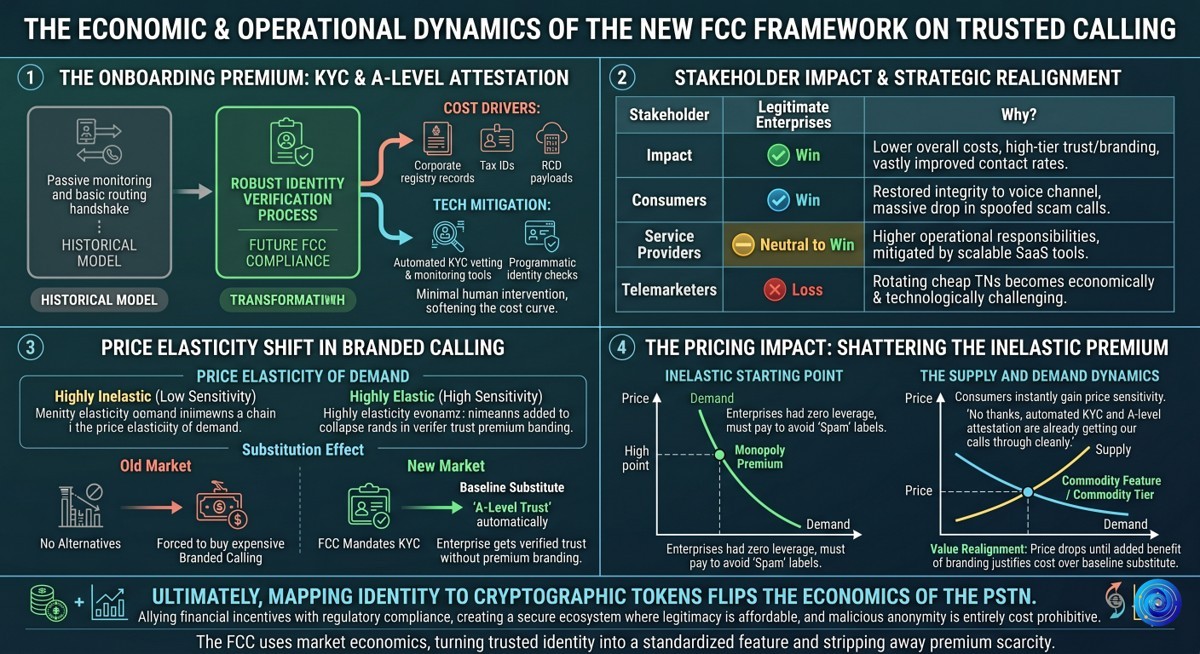
Historically, branded calling has been treated as an incredibly lucrative, premium product. If a legitimate hospital, utility provider, or financial institution suddenly had their calls aggressively labeled as “Spam” or “Scam” by terminal analytics engines, their business models faced immediate collapse. Because they had virtually zero leverage and no alternative to rescue their contact rates, their Price Elasticity of Demand was highly inelastic, which means they had to pay whatever exorbitant monopoly premium vendors demanded.
The FCC’s mandated focus on KYC and authenticated identity introduces a powerful economic force: The Substitution Effect.
- [Old Market: No Alternatives] ——> Enterprise forced to buy expensive Branded Calling
- [New Market: FCC Mandates KYC] ——> Enterprise gets baseline “A-Level Trust” automatically
When strict KYC becomes standard, a baseline call passing through the network carries cryptographically verified trust out of the box. This baseline “A-level trust” serves as a highly effective, low-cost substitute for standalone branded calling packages.
Consequently, the demand curve flattens. If a branded calling vendor attempts to charge a massive per-call premium, an enterprise can confidently decline, knowing their automated KYC and A-level attestation are already getting their calls through to the consumer cleanly.
To survive, vendors must transition branded calling from a “Monopoly Premium” to a “Commodity Feature,” driving market pricing down to a fraction of historical costs. High fees will no longer buy basic “trust”; they will only cover the cosmetic elements, such as displaying a corporate logo or a call intent message.
Mapping the Stakeholder Impact
The upcoming framework creates a distinct set of winners and losers across the telecom landscape. The operational and economic realignments are summarized below:
Stakeholder | Impact | Why? |
Legitimate Enterprises | Win | Lower overall costs for high-tier trust and branded calling features; vastly improved contact rates without premium penalties. |
Consumers | Win | Restored integrity to the voice channel; a massive drop in spoofed or unvetted scam calls hitting devices. |
Service Providers | Neutral to Win | Higher operational and policing responsibilities, but mitigated by scalable, automated SaaS vetting tools. |
Telemarketers / Bad Actors | Loss | The strategy of rotating through thousands of cheap, unvetted telephone numbers becomes economically and technologically challenging. |
Conclusion: A Rational PSTN Trust Ecosystem
Ultimately, mapping enterprise identity to cryptographic tokens via rigorous KYC is the architectural upgrade the all-IP network has desperately needed.
By ensuring that enterprises must pass through Vetting and Monitoring Agents to earn their STIR/SHAKEN A-level attestation, the FCC isn’t just cleaning up the airwaves—they are restructuring the entire market. They are stripping away the artificial scarcity that allowed basic voice channel integrity to be commercialized as a premium tier.
The future of trusted calling belongs to an ecosystem where legitimacy is highly affordable, automated, and standardized, while malicious anonymity is rendered entirely cost-prohibitive.
About Gerry Christensen
Gerry Christensen has over 35 years of experience in planning, engineering, product management and business development of telecommunications networks, applications and services. He is the founder of Wireless Waypoint, a consulting firm specializing in wireless technology solutions, and Mind Commerce, an information technology and strategy firm.
Over his career he has held leadership positions including founder and CEO of Mind Commerce, Vice President of Business Development and Strategic Alliances at YouMail, Head of Partnerships and Regulatory Compliance at Caller ID Reputation, and most recently Director of Product at 46 Labs.
Known throughout the industry for his work on communications integrity, robocall mitigation, and identity verification, Christensen has been a frequent speaker at events such as SIPNOC, TADSummit, and the Communications Fraud Control Association. His research and writing have focused on emerging approaches to identity, trust frameworks, and behavioral analytics in voice and messaging networks.
Christensen is also an innovator, for example, he is the inventor of US Patent 8,103,868, titled “Sender identification system and method,” which was issued on January 24, 2012 (filed in 2006). This patent describes a system for verifying a message sender’s identity in a communications network, an early and foundational approach to solving problems like spoofing and unauthenticated messaging.
Gerry holds a Bachelor of Science in Industrial and Systems Engineering from the University of Florida and a Master of Business Administration from Auburn University. He is author of many technical papers about various telecommunications subjects including the published reports “Yes 2 Prepay” and “Data on SS7” as well as co-author of the books “Wireless Intelligent Networking” and “Mobile Positioning and Location Management”.
If you haven't already, please take our Reader Survey! Just 3 questions to help us better understand who is reading Telecom Ramblings so we can serve you better!
Categories: Government Regulations · Industry Viewpoint · VoIP Our Main RSS Feed
 Our LinkedIn Group
 Our Facebook Page
 Follow @TelcoRamblings
 Zpoa on Security in the Cloud: SD-WAN, SASE, and Staying Ahead of Threats: “This is a great overview of how SD-WAN and SASE are evolving to address the security challenges of cloud-based and…” Sep 11, 09:35


Discuss this Post