






This Industry Viewpoint was authored by Anders Tysdal, Chief Infrastructure Officer, Tampnet
Offshore operators are under mounting pressure: ensure stable energy supply, reduce cost per barrel, improve safety and cut emissions. To deliver on these ambitions, operators are rethinking how offshore assets are connected, controlled and supported from shore.
The digital shift is a result of three decades of infrastructure investment and technological progress that have fundamentally changed what is possible for offshore industries.
What began as an effort to improve communication between platforms and shore has evolved into a high-capacity, low-latency digital connectivity enabling real-time control, collaboration and increasingly autonomous operations.
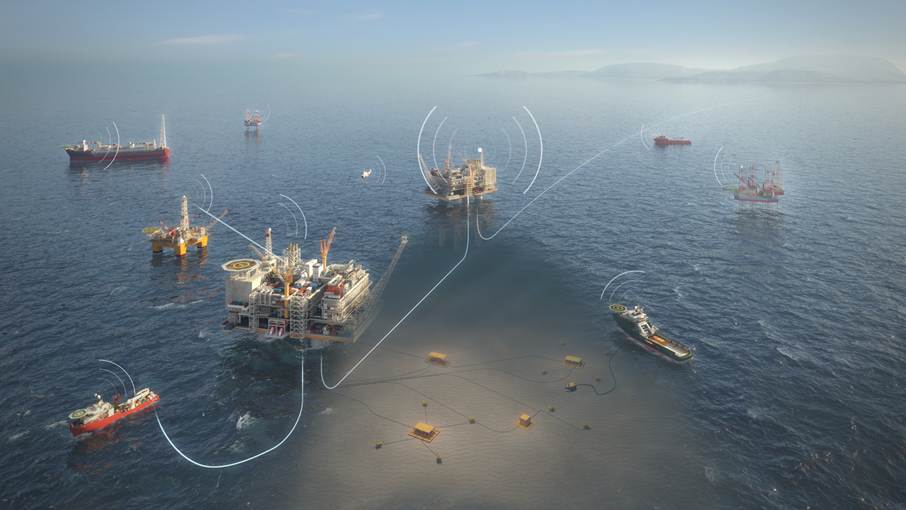
Over time, fiber-connected hubs across the North Sea and the Gulf of Mexico laid the foundation for what is now a fully integrated offshore connectivity ecosystem. The solutions from these key regions are being exported to new frontiers.
Today, that evolution can be understood in three distinct waves – each bringing operators closer to a more autonomous, data-driven operating model.
First wave: Remote operations
In the 1990s, offshore communication relied primarily on radio communication – prone to interference and limited in bandwidth and range. That model constrained efficiency and required more people present on the offshore assets.
Early deployments of subsea fiber in the North Sea and Gulf of Mexico demonstrated that high-performance connectivity could reliably transmit control signals, diagnostics and operational data between offshore assets and onshore centers over long distances.
When Troll A on the Norwegian continental shelf came online in 1995, it proved that critical offshore infrastructure could be operated differently. With more tasks performed from shore and fewer people exposed offshore, operators achieved lower OPEX and improved HSE performance.
Second wave: Connected workers
As offshore mobile networks such as 3G and 4G/LTE emerged, a second wave empowered offshore personnel. No longer tethered to control rooms or legacy radio systems, workers could use mobile devices to collaborate with onshore teams, access real-time data and perform digital inspections.
This reduced downtime, accelerated troubleshooting and enabled more efficient maintenance workflows. Tampnet’s high-speed network, now spanning 5,800 km of subsea fiber and over 450 offshore installations connected, has been central to this shift across the North Sea and Gulf of Mexico as well as other regions.
Third wave: Autonomous operations
Today, we are entering the third wave, driven by connected assets and autonomous systems. Offshore installations and vessels are being equipped with hybrid private networks, combining fiber, 5G and satellites. Offshore energy production assets generate vast amounts of data points relevant to safety, production, maintenance, logistics and monitoring.
Edge computing is becoming increasingly important for true autonomous operations, since critical decision making needs to happen close to where data is being generated. Placing computing power offshore will enable full deployment of advanced AI capabilities where machine learning,
Autonomous drone inspections, AI-powered predictive maintenance, real-time safety monitoring and remote-controlled operations all depend on resilient, low-latency connectivity. Without it, digital ambitions remain pilot projects rather than scaled solutions.
From planned unmanned operations to predictive maintenance powered by real-time sensor data, offshore industries are rapidly transitioning from digital support to digital autonomy, reducing cost and improving safety further.
For operators facing tighter margins and higher sustainability expectations, connectivity is no longer a support function – it is core infrastructure enabling the next operating model offshore.
If you haven't already, please take our Reader Survey! Just 3 questions to help us better understand who is reading Telecom Ramblings so we can serve you better!
Categories: Fiber Networks · Industry Viewpoint · Uncategorized · Wireless Our Main RSS Feed
 Our LinkedIn Group
 Our Facebook Page
 Follow @TelcoRamblings
 Glow Networks on AI Detection Makes Telecom Security More High Stakes: “Great perspective on an increasingly important topic. AI is helping telecom operators detect threats much faster, but the real challenge…” Jul 10, 15:13


Discuss this Post